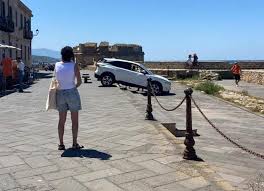
Parking properly in Alghero, when your overnight stay is in a B&B near the historic centre, means reading the city by function rather than by the number of metres shown on a map. Straight-line distance is misleading. What matters more are the ZTL, luggage drop-off, walking quality and tourist pressure at the wrong times of day.
The most useful point for the car almost never matches the ideal point for the stay. In the medieval fabric the road narrows, pedestrian flow changes pace, stone keeps moisture, and luggage weighs more than any sat-nav would have you believe. That is why it helps to think in thresholds: a drivable threshold where you stop, a pedestrian threshold where you actually enter the city, and a stay threshold which, for anyone choosing the centre, often coincides with Aigua in Alghero’s historic centre, designed precisely for experiencing the urban core on foot once the car has been left in a sensible place.
To understand the wider urban context, it also helps to read the guide to Alghero’s neighbourhoods. For physical orientation, the map of your stay and the old town and the broader guide to Alghero are useful as well.
Why parking outside the centre usually works better
The ZTL and pedestrian area are a normal part of the city, not a drama
The ZTL in the historic centre should be treated as a structural part of Alghero, not as some exceptional obstacle. It is the device that separates through traffic from the most fragile and dense part of the old town. If you arrive by car, the smartest logic is simple: use the vehicle up to the most useful edge, not to the last narrow lane. It is the easiest way to avoid mistakes, pointless turns and improvised stopping close to the access gates.
Luggage drop-off and then repositioning the car
If your B&B is in the Aigua area or near Torre Porta Terra, the best flow is often a two-step one. First step: a short arrival for drop-off only, but only if there is a permitted stopping point and the property confirms that it is practical. Second step: move the car to a stable parking area. In practice, this reduces logistical friction and turns the final stretch into a walking route, which in central Alghero is very often the most efficient option.
The most useful parking areas for a B&B near the old town
Piazzale della Pace: the clearest threshold into town
Piazzale della Pace remains one of the most functional areas for anyone heading into the historic centre afterwards. It is a transition zone between the harbour axis and the walled city. Orientation is easy. Lighting is good. The harbour itself works as a natural guide, leading you towards Banchina Garibaldi and then up to Porta Terra. In high season parking is regulated, and the official municipal rate listed for the area is 0.50 euros every 30 minutes. The real advantage, though, is not the price. It is the clarity of the shift from car to walking.
Via XX Settembre, Piazza Sulis and the ZTL edge
The areas closest to Porta Terra are more convenient only in theory. The proximity is real, but it has to be corrected by three factors: local traffic, evening crowds and narrow passages. Here the walk is shorter but denser. Wind funnels through some stretches, crowds change your walking speed, and luggage instantly exposes every uneven surface. This band works well for short or daytime parking, less so for anyone who wants a calm, low-friction arrival during peak summer hours.
Outer areas and less competitive parking
The temporary parking areas added by the municipality shift part of the pressure away from the historic core. They are not the ideal choice if you need to make two trips with heavy suitcases, but they become sensible for overnight parking or longer stays when the car will remain still. The trade-off is straightforward: a few more minutes on foot, much less competition for a space.
Where it really makes sense to leave the car: area versus function
For longer stays, stability matters more than absolute proximity
For long-stay parking, it makes more sense to prioritise areas with a clear pedestrian route, good visual control of the space, and a distance that still feels manageable in the evening. The right criterion is not getting as close as possible to the walls. It is finding a place where you can park once and leave the car there. From that point of view, Piazzale della Pace works well for multi-day stays. The multi-storey facility at Piazza dei Mercati fits that logic only if its operating status is checked before arrival.
For a short stop, proximity can make sense
If the goal is simply to arrive, unload and move on, then the edge of the centre becomes more attractive. The rule is still the same, though: no improvisation inside the historic core. Stopping properly for a short time is better than pushing into an inner stretch just to save fifty metres. Those metres are usually lost again in U-turns, waiting and the search for a workable gap.
Areas that look close but work less well
The stretches immediately beside the walls look ideal to anyone studying the map only. On the ground they are often more stressful. In summer parking is more contested, pedestrian flow becomes uneven, and the shortness of the route is overpowered by friction. Anyone arriving late or travelling with children should factor that in. The city is small, but not always forgiving.
Season, timing and cost all affect the decision
In high season, do not dramatise, just plan ahead
From late spring into summer, the harbour side and the central access axes become more sensitive to tourist pressure. Search time increases and regulated parking costs matter more. Competition rises in the middle of the day and again in the late afternoon. In that setting, the perfect space directly under your window is a false goal. It is far more efficient to choose a stable threshold and then use the centre as a continuous pedestrian space, which also happens to be the more pleasant way to experience it.
In the quieter season, there is more margin and less friction
Outside the busiest months, the whole system breathes more easily. Some central areas become less congested, and perceived distance shrinks. At that point it becomes more reasonable to try for a relatively nearby space, provided it still stays outside the tightest part of the ZTL. The city becomes easier to read, the lanes are clearer, and the route towards Aigua or Torre Porta Terra weighs less in terms of time and effort.
Logical walking routes from the car park to your B&B
From Piazzale della Pace to Torre Porta Terra and the Aigua area
The clearest route is the one that uses the harbour as its backbone. From Piazzale della Pace you head towards Banchina Garibaldi, then up to Porta Terra, and finally along the connection that leads to Via Mazzini and the Aigua area. It is a public, intuitive route with good spatial continuity. Here the city helps you: the harbour edge absorbs traffic, while the next passage introduces you gradually into the historic centre.
From the Via XX Settembre edge into the heart of town
If you find a space along Via XX Settembre or on the outer bands rather than in the historic corridor itself, the route is shorter but also more compressed. It works well for light travellers or anyone arriving at a less crowded time. It works less well if you are dragging large suitcases in the evening. Crowds slow you down, urban thresholds bunch together, and the advantage of those few saved minutes can disappear almost immediately.
Why this logic also improves the choice of where to stay
If you choose a central property, you should not chase the fantasy of parking directly under the window. You should look instead for a balance between car access and freedom on foot. That is where the link to Aigua.it becomes concrete: a base in the historic centre makes sense when it lets you leave the vehicle on the useful edges and then move around without traffic, without repeated departures and without depending on the car for every minor shift. It is simple urban logic. Miraculously, it works.
FAQ: parking near an Alghero historic centre B&B
Where should I park if my B&B is in the historic centre or close to Aigua?
In general, it is best to choose an area along the main access edges to the centre, especially Piazzale della Pace or the outer margins of Porta Terra, and complete the final stretch on foot.
What is the most practical parking area near Torre Porta Terra?
Piazzale della Pace remains one of the most straightforward solutions in terms of orientation, access and walking route towards Torre Porta Terra.
Is it difficult to drive in Alghero’s historic centre?
The difficulty is not the size of the town but the ZTL, the access gates and the medieval street pattern. In many cases it is easier to stop outside and walk in.
How much does parking cost in summer?
Prices vary by area and season. For Piazzale della Pace, the municipality lists a regulated rate of 0.50 euros for every 30 minutes during the paid period. Other locations should be checked before arrival.
Where should I park if I have heavy luggage or children with me?
A more stable, easier-to-read parking area is usually better, even if it is slightly farther away, than a stressful search right on the edge of the old town. Walking quality matters more than sheer closeness.
Does it still make sense to stay in the centre if the car remains outside?
Yes. For many stays it is the best solution: you use the car on arrival and departure, while the historic centre is enjoyed on foot in a much freer way.
Related reads
To complete the picture, you can also read where to stay in Alghero by area, consult the map of the historic centre, and look directly at Aigua B&B Alghero if you want a base designed for moving around on foot once the car has been parked.